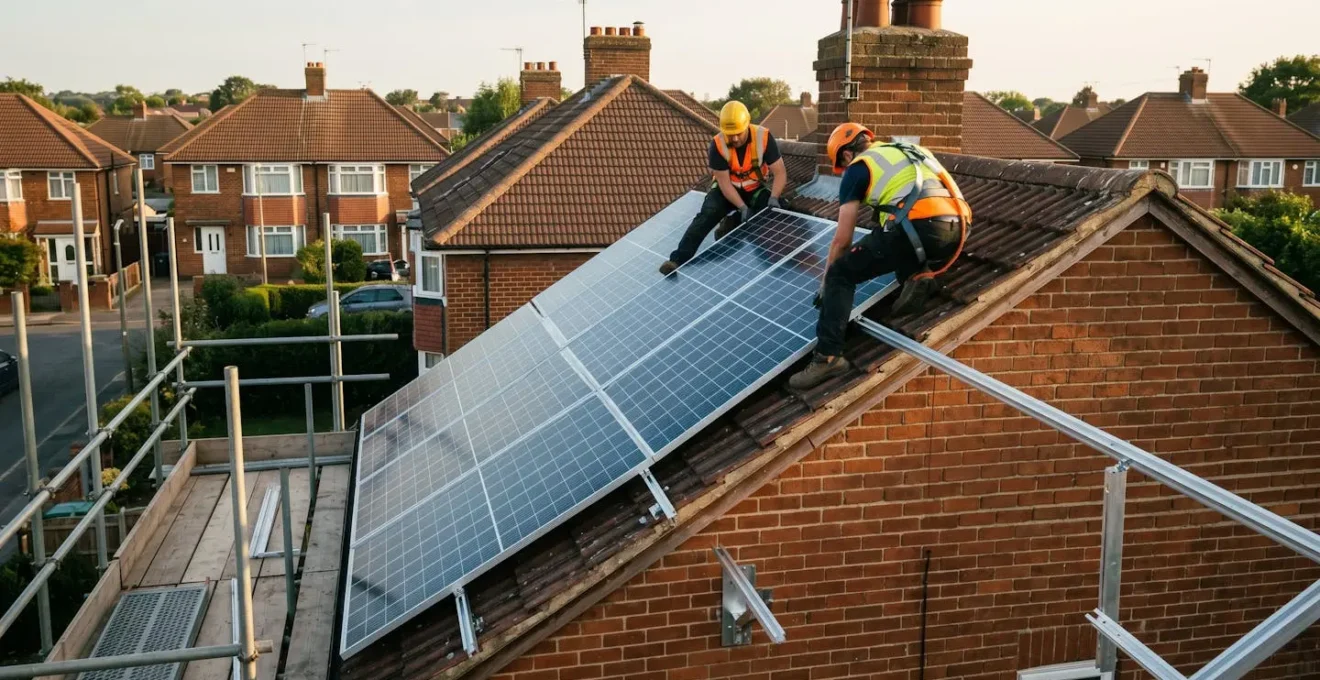
Picture a typical January morning in the Midlands: grey skies, heating running full throttle, and your electricity meter spinning relentlessly. Now imagine that same household generating 60–70% of its own power from roof-mounted photovoltaic panels, slashing grid dependence even during Britain’s notoriously variable climate. For thousands of UK homeowners, this shift from passive consumer to active generator represents not just financial savings of £400–900 annually, but genuine energy autonomy. Yet the path from initial curiosity to operational system involves navigating MCS certification, DNO approval processes, and equipment choices that separate a sound 7-12 year return on investment from a costly mistake.
Understanding the three main photovoltaic technologies narrows your options before requesting quotes. Each chemistry delivers different efficiency rates, costs per watt, and suitability for British housing stock (typically space-constrained terraced and semi-detached properties). The most commonly overlooked factor in UK installations is matching panel technology to roof limitations rather than chasing the lowest upfront price.
The UK regulatory framework shapes every installation decision. MCS certification remains mandatory for Smart Export Guarantee payments and manufacturer warranty validity, while DNO grid connection approval timelines vary significantly by region — G98 applications (under 3.68kW) typically clear within 2 weeks, whereas G99 systems require 4-8 weeks for manual capacity assessment. Building Control notification under Part P electrical regulations completes the compliance triangle, with professional installers holding Competent Person Scheme membership streamlining the entire process from survey through commissioning.
Your 3 installation priorities before committing £5k+
- MCS certification is non-negotiable: non-certified installations forfeit Smart Export Guarantee payments (£150-£300 annually) and void most manufacturer warranties, costing £2k-£5k over 10 years
- Timeline reality check: physical installation takes 1-3 days, but DNO approval, Building Control certification and MCS paperwork extend total project to 6-12 weeks depending on regional operator
- UK climate ROI: 4kWp system (£5k-£7k) saves £400-£900 yearly with 7-12 year payback; northern regions and heavily shaded roofs push towards upper timeline, London and South East towards lower
Choosing the right photovoltaic technology for your roof
Navigating the technical specifications of various panel types requires a strategic approach to ensure long-term performance. To bridge the gap between initial design and operational success, accessing professional advice on diverse solar energy solutions remains the most effective way to validate equipment compatibility. Expert guidance helps homeowners select hardware that withstands specific environmental conditions while maintaining structural integrity, ensuring the transition to a sustainable power source is both reliable and seamless.
Monocrystalline cells: premium efficiency for limited spaces
Monocrystalline panels use single-crystal silicon wafers, delivering efficiency rates of 18–22% — the highest available for residential installations. This translates directly to more kilowatt-hours per square metre, critical for UK terraced and semi-detached homes where roof real estate rarely exceeds 25-35m². Modern bifacial monocrystalline panels in the 400-720W range capture reflected light from roof tiles or ground surfaces, adding 5-10% extra generation in optimal conditions. The premium cost — typically £0.90-£1.10 per watt — pays dividends when every square metre counts, with warranty documents showing approximately 90% performance at 10 years and 80% at 25 years.
Polycrystalline modules: budget-friendly without major compromise
Polycrystalline technology melts multiple silicon fragments together, creating a slightly less efficient but more economical cell structure. Efficiency rates of 15-17% mean you’ll need roughly 15-20% more roof area to match monocrystalline output, but upfront costs run 10-15% lower (£0.75-£0.95 per watt). For detached properties with 40m²+ of unshaded south-facing roof, polycrystalline arrays represent solid value with degradation rates trending slightly higher (approximately 85% performance at 10 years, 75% at 25 years).
Thin-film technology: flexible solutions for unconventional setups
Thin-film panels (cadmium telluride or CIGS chemistry) sacrifice efficiency (10-12%) for flexibility and superior performance in partial shading or high-temperature conditions. While rarely the first choice for standard pitched roofs, thin-film excels in flat roofs where ballasted mounting avoids penetrations, building-integrated photovoltaics where aesthetics trump output, or mobile installations. For properties with Listed Building restrictions requiring discrete integration, the technology offers viable pathways with 20-25 year warranties.
| Criterion | Monocrystalline | Polycrystalline | Thin-film |
|---|---|---|---|
| Efficiency range | 18-22% (highest residential) | 15-17% | 10-12% |
| Cost per watt (2026 UK) | £0.90-£1.10/W | £0.75-£0.95/W (10-15% cheaper) | £0.60-£0.80/W |
| Lifespan & warranty | 25-30 years (90% performance year 10, 80% year 25) | 25 years (85% year 10, 75% year 25) | 20-25 years (faster degradation) |
| Best UK use case | Limited roof space (terraced, semi-detached), partial shading, max kWp priority | Large roofs (detached), tight budgets £5k-£6k, south-facing unshaded | Flat roofs, mobile (caravans), aesthetic integration (BIPV), high-temp environments |
| Available options | Bifacial monocrystalline 400-720W modules | Standard polycrystalline arrays | Flexible specialist solutions |
The transition from panel selection to practical feasibility hinges on verifying whether your specific property can physically and legally accommodate an array.
Calculate whether your property suits solar installation
-
Orientation acceptable: South, south-west or south-east facing roof (east or west viable but 15-20% lower output; north-facing UK uneconomical)
-
Minimal shading 9am-3pm: No tall buildings, mature trees or chimneys casting shadows during peak sun hours (more than 30% daily shading kills ROI)
-
Roof age and condition: Roof less than 15 years old or recently inspected; panels last 25+ years, re-roofing after installation costs £3k+ removal and reinstallation
-
Sufficient roof area: Minimum 20m² unobstructed (roughly 12-14 panels for 4kWp system); terraced properties often limited to 2.5-3kWp
-
No Listed Building restrictions: Listed Buildings and Conservation Areas require planning permission (often refused); standard homes benefit from Permitted Development rights
Roof orientation and pitch determine your baseline generation potential. According to Building Regulations guidance, south-facing roofs at 30-45 degree pitch deliver optimal performance in the UK, though south-west and south-east orientations sacrifice only 5-10% output. East or west-facing arrays remain viable if unshaded, but north-facing installations rarely justify investment outside of specialist off-grid scenarios. Google Maps satellite view provides instant orientation verification; measure the angle between your roof’s perpendicular line and true south (not magnetic).
Shading analysis separates theoretical capacity from real-world generation. Persistent shading from neighbouring buildings or mature trees can reduce output by 20-40%; certified suppliers like use drone imaging and shading analysis tools during initial surveys to quantify these losses accurately before quoting. Morning shadows (7-10am) matter less than midday-to-afternoon shading (11am-4pm), when solar irradiance peaks. A single chimney casting shade across three panels in a string-wired system can drag down the entire string’s performance — a scenario micro-inverters or optimisers mitigate but at added cost.
Structural capacity and available space impose hard physical limits. BS EN 1991 structural load standards require roofs to support 10-15 kg per square metre of additional load from panels, mounting hardware and occasional snow accumulation. Pre-1960s properties with original timber joists often need professional structural surveys; a 4kWp system (12-16 panels) occupies approximately 20-25m² and weighs 240-360kg total. Building Control officers frequently flag undersized rafters or degraded roof timbers during inspections, triggering costly remediation before installation proceeds.
Consider a 1980s semi-detached property in Birmingham: south-west facing roof (optimal), 28m² available space, partial shading from neighbour’s oak tree between 2-4pm. MCS survey identified 3.5kWp viable capacity (not full 4kWp due to shading), projected generation 2,950kWh annually, offsetting household’s 4,200kWh consumption by 70%. Initial quote £5,800 (£1,657/kWp), ROI timeline 9.5 years accounting for shading losses. Tree trimming negotiation could reduce timeline to 8 years.
Once you’ve verified basic suitability through this initial self-assessment, professional MCS site surveys calculate precise system sizing, confirm structural adequacy, and model realistic generation forecasts using your postcode’s solar irradiance data (which varies significantly between Glasgow at 900 kWh/m²/year and Plymouth at 1,100 kWh/m²/year). This professional validation step eliminates guesswork and manages expectations before you commit capital.
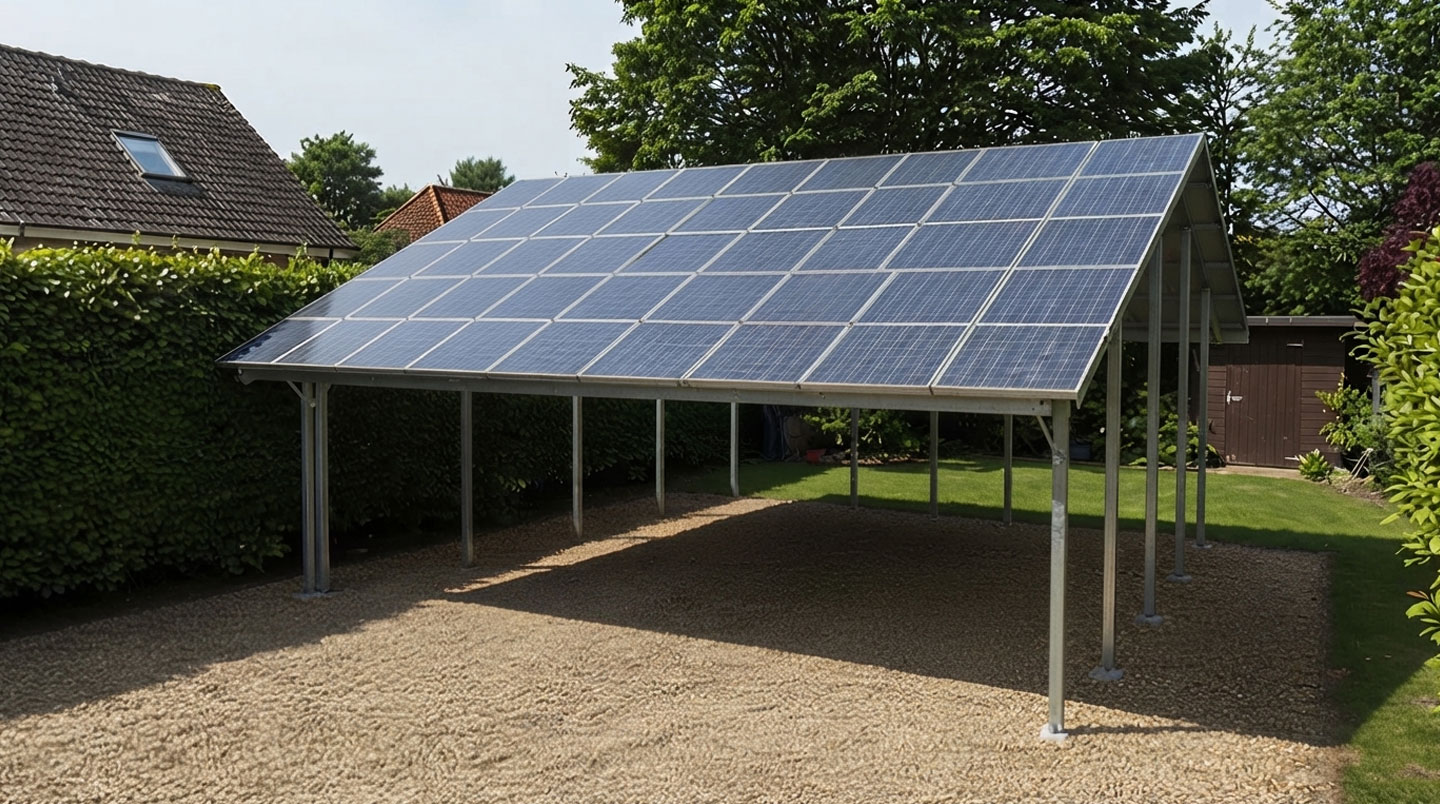
What equipment you’ll need beyond the panels themselves
A functioning solar array comprises three core components beyond the photovoltaic modules: inverters to convert DC electricity to usable AC current, mounting systems to anchor panels securely, and increasingly, battery storage to shift consumption towards evening peaks.
Inverters: converting DC power to usable AC electricity
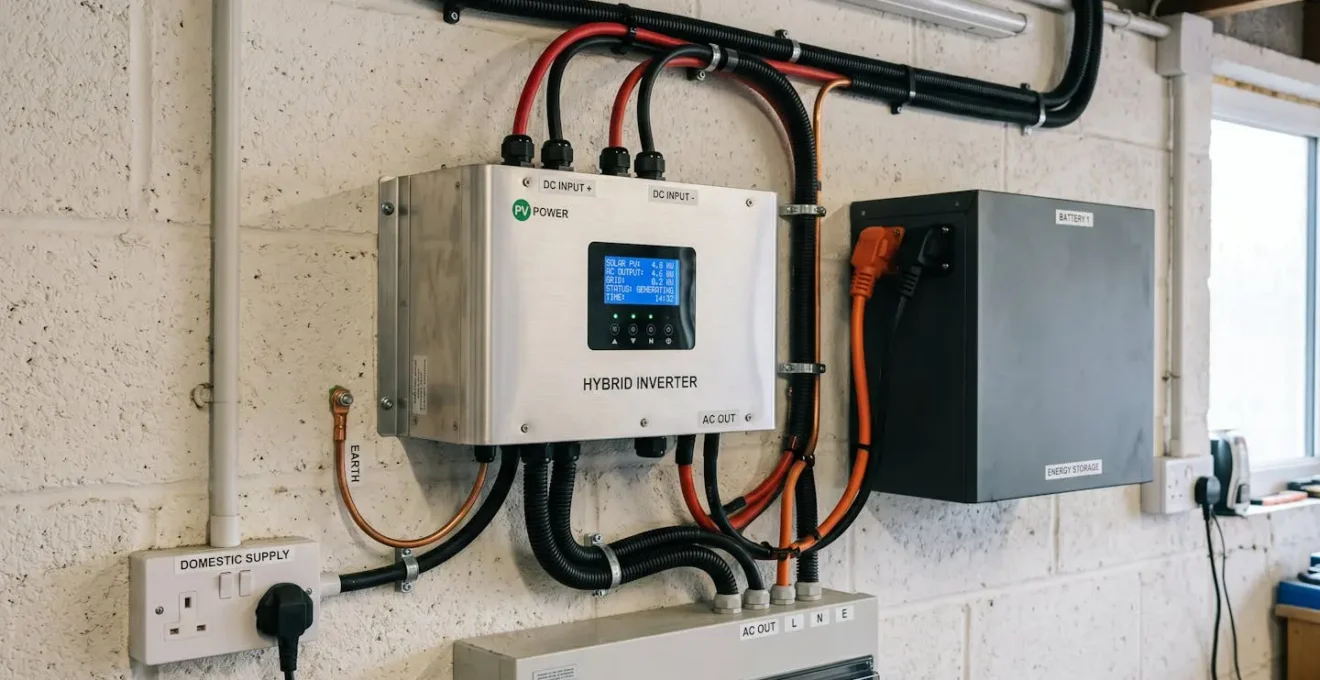
The inverter transforms high-voltage DC current from your panels (typically 300-600V) into 230V AC that feeds your consumer unit and household circuits. String inverters (£800-£1,200) connect panels in series, offering economical simplicity but suffering efficiency losses if even one panel underperforms. Micro-inverters (£1,500-£2,000) attach to each panel individually, optimising output panel-by-panel. Hybrid inverters (£1,800-£2,500) in the 1.5-11kW capacity range integrate battery storage capability from day one, future-proofing your system without replacing core equipment. Inverter capacity should match 80-90% of your array’s peak kWp rating.
Mounting hardware: anchoring your array safely to the roof
Mounting systems must withstand BS EN 1991 wind load calculations while maintaining waterproof integrity for 25+ years. Railed systems use aluminium rails bolted through flashing plates into rafters, providing adjustable tilt and robust panel retention. Ballasted systems for flat roofs avoid roof penetrations entirely, using weighted trays (though adding 15-25 kg/m² load). Stainless steel fixings resist corrosion in Britain’s damp climate; a frequent mistake involves using galvanised rather than stainless fasteners, leading to rust failure within 8-12 years.
Battery storage: maximising self-consumption and grid independence
Real-world UK performance typically delivers battery ROI only under specific conditions: time-of-use tariffs (Octopus Agile, Economy 7), high export volumes with low daytime consumption, or frequent power cuts requiring backup. Lithium iron phosphate (LiFePO4) chemistry offering 15.36kWh modular capacity delivers 6,000+ cycles and 10-12 year lifespan. Adding battery storage increases self-consumption from typical 40% to 70-80%, especially valuable when SEG export tariffs range only 3.0-5.5p per kWh compared to grid import rates of 24-30p. The £4k-£6k investment adds 8-10 years to payback timelines, making batteries a strategic choice rather than universal necessity.
With equipment specified, the actual installation process reveals how MCS-certified contractors orchestrate compliance, safety and commissioning.
How professional installers execute a residential solar project
Realistic project timelines span 6-12 weeks from initial survey to final MCS certification, with DNO approval comprising the primary variable. Physical installation occupies just 1-3 days; the surrounding paperwork and regulatory compliance extends the schedule. Week 0 begins with site survey; weeks 1-2 cover quoting and contract signing; weeks 2-8 await DNO grid connection approval; weeks 8-9 execute physical installation; weeks 10-12 finalise Building Control notification and MCS certificate issue.
Initial survey: mapping sun exposure and structural capacity
MCS-certified installers conduct comprehensive site surveys using Solar Pathfinder devices or drone-mounted imaging to map shading patterns across seasons, measure roof pitch and orientation, inspect structural timber for load-bearing adequacy, and assess your consumer unit’s capacity for additional circuits. They review 12 months of electricity bills to model consumption patterns and right-size the array — a 4kWp system suits households using 3,500-4,500 kWh annually. The survey output includes detailed system design, DNO pre-approval confirmation, and itemised quote separating equipment, labour, scaffolding (often £500-£800) and certification costs.
Securing the racking system without compromising waterproofing
Installation focuses on scaffolding erection, locating roof rafters beneath tiles using stud finders, and fixing aluminium mounting rails via stainless steel bolts penetrating flashing plates. MCS-certified installers recommend marine-grade stainless fixings in coastal areas where salt corrosion accelerates degradation. Waterproof flashing plates create compression seals around each penetration point; improper installation voids home insurance if subsequent leaks occur. Panels slot into rail clips and are torqued to manufacturer specifications, then wired in series or parallel strings according to inverter input voltage requirements.
Wiring the array and connecting to your consumer unit
DC cabling from the array runs through UV-protected conduit to the inverter location (garage, loft or external wall-mount), sized to minimise voltage drop — undersized cables cause 5-8% generation losses. The inverter connects to your consumer unit via dedicated AC circuit breaker (16-32A rating), with generation meter and isolator switches satisfying G98 or G99 requirements. This electrical work is notifiable under Building Regulations Part P; MCS installers holding Competent Person Scheme membership (NICEIC, NAPIT) self-certify, issuing Building Compliance Certificates within 4-6 weeks. The installer submits DNO notification, and upon commissioning, provides system documentation enabling SEG registration.
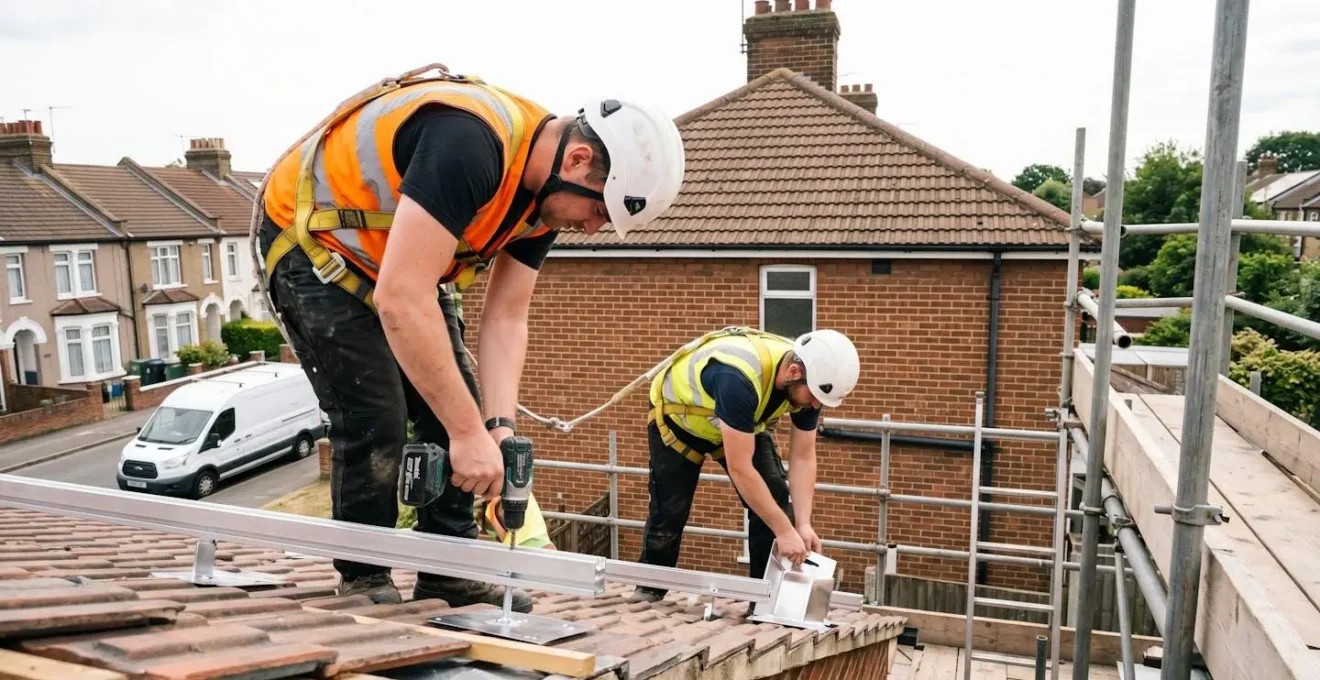
Electrical work on solar PV systems is notifiable under Building Regulations Part P. DIY installation without Competent Person Scheme qualifications can invalidate home insurance and void manufacturer warranties.
Working at height without proper fall protection equipment carries fatal risk. HSE reports 40+ deaths annually from roof falls in UK construction sector.
DC voltage from solar arrays can exceed 600V. Improper wiring or isolation can cause electric shock, arc flash or fire even on cloudy days.
MCS certification is required to access the Smart Export Guarantee (SEG). Non-certified installations cannot sell surplus electricity to the grid, forfeiting £150-£300 annually.
Consult MCS-certified solar installer (search mcscertified.com register) and Building Control-approved electrician (NICEIC, NAPIT or equivalent Competent Person Scheme).
Keeping your system performing at peak capacity over decades
Photovoltaic arrays rank among the lowest-maintenance home improvements you can make — no moving parts, no combustion, no scheduled servicing comparable to boilers or heat pumps. Rain typically provides sufficient panel cleaning in most UK regions; only properties near agricultural operations (dust accumulation) or under flight paths (jet fuel residue) require annual washing. Your primary maintenance obligation centres on monitoring output rather than physical intervention.
Check your inverter’s monitoring app or display monthly to verify generation aligns with seasonal expectations. Sudden drops (15%+ below equivalent previous months) signal potential faults: panel micro-cracks from hail or thermal stress, inverter component failure, or loose DC connections. Modern inverters log performance data accessible via smartphone apps, flagging anomalies automatically. Clean panels only if bird droppings, moss or heavy soiling are visible; hire professional roof-access contractors rather than DIY ladder work (HSE guidance classifies any work above 2 metres as requiring fall protection).
-
Monthly: Check monitoring app for generation consistency and inverter fault codes
-
Annually: Visual inspection after storms for damaged panels or loose fixings; clean panels if heavy soiling present (hire professional for height work)
-
Every 5 years: Professional electrical inspection of DC and AC circuits, mounting hardware corrosion check
-
10-12 years: Budget for inverter replacement (typical lifespan 10-12 years vs 25-30 year panel lifespan)
Schedule professional electrical inspections every 5 years to verify DC cable integrity, check earthing continuity, and inspect mounting hardware for corrosion or loosening. Most MCS installers offer maintenance contracts (£80-£150 annually) covering these checks. Budget for inverter replacement at the 10-12 year mark (though warranties often cover 5-10 years); battery systems using LiFePO4 chemistry require replacement around year 10-12 as well.
Manufacturer warranties provide the safety net: panels carry 25-year performance guarantees (typically 80% capacity retention), inverters warrant 5-12 years depending on type (string vs hybrid), and batteries guarantee 6,000-10,000 cycles or 10 years. Document all maintenance in a system log to preserve warranty validity. Solar panels work most efficiently when paired with comprehensive energy efficiency measures like attic insulation for energy savings, reducing overall consumption and maximising self-sufficiency rather than relying solely on generation to offset waste.
Professional MCS-certified installation eliminates the guesswork and ensures compliance from day one, protecting your ROI through warranty preservation, SEG eligibility, and insurance coverage. Start by requesting quotes from at least three MCS-registered installers (verify credentials at mcscertified.com), comparing not just upfront cost but equipment specifications, warranty terms, and post-installation support. Verify that quotes itemise scaffolding, Building Control fees, and DNO application costs separately to avoid surprise additions. Installing solar is one step in a broader sustainable home strategy; explore how eco-construction for sustainable homes integrates renewable energy, efficient insulation and resource conservation into a cohesive approach that compounds savings year after year.
Do I need planning permission for solar panels on my UK home?
Most UK residential solar installations qualify as Permitted Development, requiring no planning permission if panels don’t protrude more than 200mm beyond the roof plane and aren’t installed on walls facing highways. Exceptions requiring Local Authority approval: Listed Buildings, properties in Conservation Areas, Areas of Outstanding Natural Beauty, National Parks, or World Heritage Sites. Standard suburban semi-detached and terraced homes typically proceed without planning permission; verify with your Local Planning Authority if uncertain.
What’s the difference between MCS certification and Building Regulations Part P?
MCS certifies the installer and system design meet renewable energy quality standards; it’s mandatory for Smart Export Guarantee eligibility and most manufacturer warranties. Building Regulations Part P governs electrical safety for AC wiring connecting your system to the consumer unit; compliance requires either a Competent Person Scheme electrician (NICEIC, NAPIT) who self-certifies, or notification to Local Authority Building Control for inspection. MCS installers typically hold both accreditations, covering both requirements in one contractor.
How long does DNO approval actually take in 2026?
DNO approval timelines vary by system size and regional operator. G98 applications (under 3.68kW single-phase) are often auto-approved within 2 weeks. G99 applications (over 3.68kW) require manual DNO review of grid capacity and can take 4-6 weeks, occasionally extending to 8-12 weeks if grid reinforcement assessment is needed. Scottish Power, UK Power Networks and SSE each have different processing speeds; your MCS installer will know typical timelines for your postcode’s DNO.
Can I install solar panels myself to save £1,500-£2,000 labour costs?
DIY solar installation is legally possible but economically unwise for most homeowners. You forfeit: MCS certification (losing Smart Export Guarantee income of £150-£300 yearly, totalling £1,500-£3,000 over 10 years), manufacturer warranties (£800 inverter replacement not covered), home insurance coverage if Part P electrical work isn’t certified (potential £10k+ liability for fire or electrical fault), and DNO may refuse grid connection without MCS installer sign-off. Hidden costs include cable sizing errors causing 5-8% production loss (£40-£70 yearly) and improper roof flashing causing leak damage (£2k+ repairs). The apparent £1,500 labour saving becomes £3k-£5k net loss over 10 years.
Is battery storage worth the £4k-£6k investment with current SEG rates?
Battery ROI depends on your tariff structure and self-consumption goals. Viable scenarios: time-of-use tariffs like Octopus Agile (store cheap off-peak, release during 16:00-19:00 peak rates of 30-40p per kWh), payback 8-10 years; high daytime export with low on-site use (office workers), increasing self-consumption from 40% to 70-80% saves more than SEG’s 3-5.5p per kWh export; frequent power cuts requiring backup resilience. Poor ROI if you have flat-rate tariffs and high daytime consumption (already self-consuming over 60%). Alternative strategy: install solar now with hybrid inverter (battery-ready), add battery in 2-3 years when LiFePO4 prices drop another 15-20%.